
The Real Reason Your Gut Symptoms Are Getting Worse in Perimenopause
Have you ever felt like you’re doing everything right, changing your diet, trying supplements, avoiding foods, exercising more, and yet your bloating, gut pain, and midsection weight just won’t budge?
If that sounds familiar, there’s a good chance you’re making one very common mistake that keeps many women stuck with IBS symptoms in midlife: you’re trying to fix your gut, but you’re not supporting the system that controls your gut.
This is a very common mistake, and it makes sense that so many women fall into this trap. When you feel miserable, you’ll try almost anything to feel better. Friends recommend supplements, the internet promises that the next diet will fix everything, and doctors are often focused on diagnosing serious medical conditions, not necessarily walking you through why you’re bloated every day.
But here’s what many women are never told: digestion is controlled by the nervous system.
And if the nervous system is constantly in stress mode, digestion simply cannot work the way it’s supposed to (yes, we’re talking about the nervous system in a blog post about gut symptoms!).
In this post, we’re going to show you why this mistake happens, why it keeps you stuck in a cycle of gut flares, and what we do inside the Balanced Gut Solution program instead so you can reduce bloating, calm digestion, and finally start seeing changes in your midsection again without more restriction or more intense exercise.
Let’s break it down.
Why Diets, Supplements, and Elimination Diets Aren’t Fixing the Problem
One of the most important things to understand about IBS in midlife is that digestion is not just about food. It’s about the gut–brain connection, also called the gut–brain axis. This is the communication system between your nervous system and your digestive system.
When this communication system is out of balance, you can eat very healthy foods and still feel terrible.
Here are a few ways ignoring the gut–brain connection keeps women stuck.
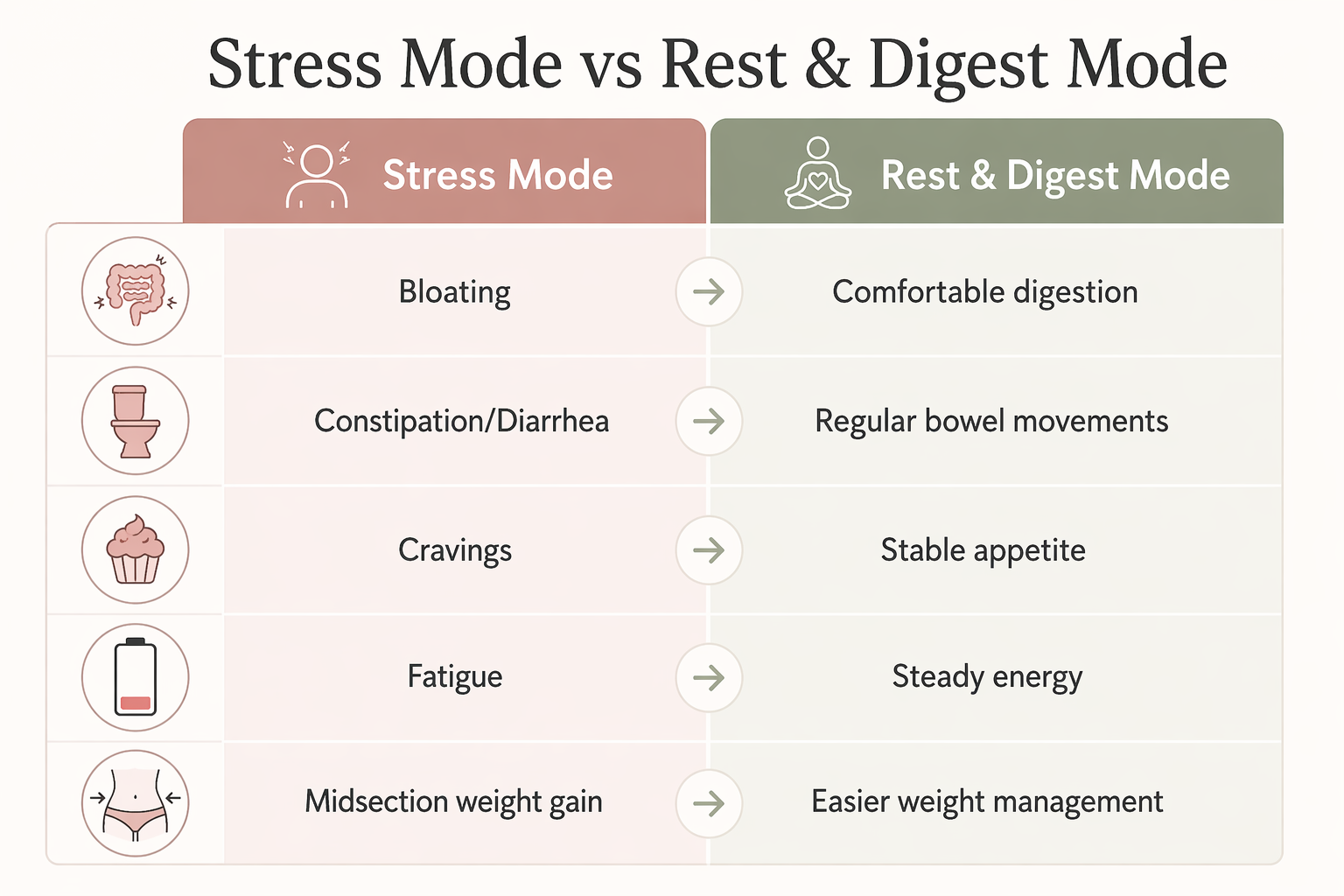
1. Your Body Stays in “Stress Mode,” Not “Digest Mode”
Digestion works best when the body is in a calm, “rest and digest” state. But many women in midlife are constantly in “go mode.”
When the nervous system is chronically stressed:
Stomach acid and digestive enzymes, which help break down food, decrease
Gut motility (how quickly or slowly food moves through your digestive tract) becomes irregular, leading to constipation or diarrhea
Blood flow is redirected away from digestion, which means less oxygen is going to your digestive system, making it harder for your body to break down food
This means even healthy foods can cause bloating, gas, or discomfort, not because the food is bad, but because the body isn’t in a state where digestion works well.
We see this all the time with clients who are working very hard on their diet but still feel like everything they eat makes them bloated.
2. Your Gut Becomes More Sensitive When You’re Stressed
When the nervous system is overwhelmed, the gut becomes more sensitive to normal digestion.
Things like normal gas movement or intestinal stretching after eating can be felt as pain, pressure, or bloating.
So even when digestion is doing what it’s supposed to do, it still feels uncomfortable.
This is one reason many women feel like their symptoms are getting worse, even when they’re trying harder and harder to fix them.
3. Bowel Movements Become Unpredictable
The gut–brain connection strongly affects how quickly or slowly food moves through the digestive tract.
When the nervous system is stressed, motility may become:
Slower (constipation)
Faster (diarrhea)
Inconsistent (alternating between the two)
Many women then focus only on fiber, supplements, or elimination diets without realizing that nervous system regulation is also a big part of stabilizing digestion.
4. It Keeps You Stuck in the Quick-Fix Loop
This is the pattern we see most often. Women try:
Multiple supplements
Different diets
Gut protocols
Testing and retesting
They might feel better for a short time, but symptoms keep coming back because the nervous system piece was never addressed.
And women are left feeling like they’re trying everything but never getting lasting relief.
“But My Symptoms Are Physical and This Sounds Like It’s All in My Head”
Many women hear “nervous system” and think they are being told their symptoms are in their head. That is not what this means.
Your symptoms are real. The bloating is real. The pain is real. The constipation or urgency is real.
But digestion is directly controlled by the nervous system, and when the body is constantly in stress mode, the gut cannot function smoothly, no matter how carefully you eat.
Many women we work with have tried multiple diets, supplements, and gut protocols before they reach us. What they often discover is that their gut was never given the conditions it needs to function well in the first place.
Before we try to fix the gut, we have to stabilize the system the gut operates in.
Why Everything Suddenly Stopped Working in Your 40s and 50s
Many women notice that their gut symptoms get worse in their 40s and 50s, and this is not a coincidence.
During perimenopause and menopause, several things are happening at the same time:
Hormonal changes affect gut motility (how quickly/slowly food moves through the digestive system)
The nervous system becomes more sensitive to stress
Sleep often becomes lighter or more disrupted
The body does not recover from stress as quickly as it did in your 20s and 30s
Fat storage shifts to the midsection
This means the same strategies that worked when you were younger often make gut symptoms worse in midlife, not better.
It’s not that there’s something wrong with you.
It’s that your body is in a different stage of life and needs a different strategy.
What Actually Helps Your Gut Calm Down and Heal in Midlife
So if the problem isn’t just food, and it isn’t just your gut, what should you focus on instead?
When we work with women in perimenopause and menopause, we don’t start with more restriction. We start with creating the conditions that allow the gut and nervous system to work together again.
Here’s What We Do Differently
Inside the Balanced Gut Solution, we focus on five key areas:
Stabilizing eating rhythm
Eating in a calm, “digest mode” state
Daily nervous system regulation
Sleep/wake/biological rhythm support
The right kind of movement for midlife
1. Build an Eating Rhythm Your Gut Can Depend On
Many women in midlife have lost a predictable eating rhythm, and the gut really depends on rhythm to work well. Irregular eating, grazing all day, skipping meals, or eating at wildly different times sends confusing signals to the gut and nervous system.
Try this instead:
Eat 3 structured meals per day rather than constant snacking
Leave 3–4 hours between meals
Sit down to eat instead of eating while working or driving
Try to eat meals at similar times each day
Your gut has its own internal rhythm. When eating is chaotic, digestion becomes chaotic too.
We’ve seen many clients reduce bloating just by stabilizing meal timing and stopping constant snacking.
2. Learn to Eat in “Digest Mode,” Not “Rush Mode”
Digestion actually starts in the brain. If you eat while stressed, working, or rushing, your body is not prioritizing digestion.
Try this:
Take 3 slow breaths before the first bite
Close the laptop and put down your phone
Put your utensils down between bites
Chew each bite 20–30 times
Slow down the first 5 minutes of the meal
This sounds simple, but it is incredibly powerful when done consistently. Many of our clients notice less bloating just from breathing before eating and slowing down meals.
3. Give Your Nervous System Some Love Every Day
This does not have to be complicated or time-consuming. Small daily habits can help retrain the nervous system to feel safe, which helps digestion work better.
Examples:
Slow breathing with an extended exhale, especially before meals
Humming or singing in the car or shower
Gargling with water for 30 seconds
Light walking after meals
None of these require an app or a special program. They’re small daily habits that help retrain the nervous system toward a calmer baseline over time.
4. Stop Fighting Your Body’s Natural Rhythm
Your gut and your nervous system like routine. They work best when your body has a regular rhythm - waking, eating, and sleeping around the same times each day. When that rhythm gets thrown off, stress hormones get thrown off too, and that can show up as bloating, constipation, cravings, and blood sugar swings.
You can help reset your body’s rhythm by:
Getting 10–15 minutes of natural light within the first hour of waking
Eating your first meal within an hour of rising
Keeping sleep and wake times consistent to help regulate cortisol (stress) hormone rhythms, which directly influence gut motility and digestive function throughout the day
During perimenopause and menopause, the body is more sensitive to stress and hormone changes. That means these small, simple habits make a much bigger difference than most women expect.
5. Move in Ways That Calm Your Body, Not Tax It
Intense exercise can actually worsen gut symptoms when the nervous system is already stressed, which is something many women discover after years of pushing hard in the gym.
Movement that tends to help instead:
Short walks after meals
Yoga or gentle stretching in the evening
Moderate strength training 2-4 days/week
The goal is movement that lowers stress hormones and helps your body shift into “rest and digest” mode, not exercise that adds more physical demand to a system that’s already taxed.
In this phase of life, the body responds better to consistent, supportive movement than to “all or nothing” workouts.
6. Take Sleep Seriously
Poor sleep increases gut sensitivity, disrupts the microbiome, and makes the nervous system more reactive. If sleep is suffering, the gut will react.
A few practical habits that help:
Consistent sleep and wake times, including weekends
No big meals within two to three hours of bedtime
Limiting screens and bright light in the evening
Even ten minutes of a wind-down routine makes a difference
During perimenopause and menopause, sleep is often disrupted by hormonal changes, but improving sleep is one of the fastest ways to improve gut symptoms.
Sleep is not a luxury in midlife; it’s part of your gut healing plan.
What Happened When One Client Stopped Trying to “Fix” Her Gut
One of the busy moms we worked with, Anne, came to us exhausted and frustrated. Her days started at 4:30am with high-intensity workouts, she carefully restricted her food choices to avoid flares, worked a full day, then spent her evenings managing her kids and helping with the family business. By 11pm she was completely depleted, and despite all of that effort, her gut symptoms were getting worse.
Anne came to work with us looking for a new approach to healing her gut symptoms, and for accountability in taking the steps necessary to heal.
To start, we didn’t add anything to Anne's plate. We took things away and shifted what remained. The early morning workouts were replaced with lunch hour walks, she carved out a few minutes during the workday for slow breathing and quiet prayer, which fit naturally with her faith, and we moved her bedtime earlier so her body could actually recover.
About a month later the shift was noticeable. Anne seemed more settled, her digestive symptoms had already begun to calm, and she’d lost a few pounds with less restriction. Her body hadn’t needed another protocol. It had needed the conditions to finally step out of survival mode so she could start healing.

If You’re Exhausted from Trying, This Part Is for You
You've been doing a lot. Managing your symptoms, researching, adjusting, starting over. That takes real effort, and it makes sense that you're tired of it.
The women who find their way to us usually aren't looking for one more thing to try. They're looking for someone to finally help them understand what's actually been going on.
The problem may not be that you haven’t found the right diet yet. The problem may be that your body has been stuck in stress mode for so long that digestion hasn’t had a chance to work the way it’s supposed to.
When you start supporting your nervous system, creating rhythm with meals, slowing down, sleeping better, and using the right kind of movement for your body at this stage of life, something really important happens:
Your body starts to feel safe again.
And when the body feels safe:
Digestion works better
Inflammation calms down
Bloating improves
Energy becomes more stable
The midsection weight often becomes easier to manage
It’s not just about food. It’s the environment your body is living in every day.
Ready to Stop Guessing? Here’s What To Do Next
If you’ve been bouncing between diets, supplements, and food restrictions without finding lasting relief, the next step might not be another protocol. It might be starting here; with the foundational nervous system support your gut has been missing.
The women who do best in the Balanced Gut Solution are those who are done guessing, ready to understand what's actually happening in their bodies, and looking for support that treats them as an intelligent, capable woman rather than a list of symptoms to manage.
The next step is simple:
Book a free gut health assessment call with Ava or Meg. There's no obligation; just an honest conversation about where you are, what you've already tried, and whether working together feels like the right fit. You'll leave the call with more clarity than you came in with, regardless of what you decide.
Schedule Your Gut Health Assessment Call Here

Ava Safir and Meg Whitbeck are Registered Dietitians and gut health coaches specializing in women navigating perimenopause and menopause and struggling with digestive issues. They are co-founders of Balanced Gut Coaching, which they built after recognizing how consistently this group of women was being underserved, sent home with normal labs and no real answers while their daily lives were being organized around their digestion. Ava and Meg bring both clinical expertise and deep personal experiences with gut health challenges to their work and have helped hundreds of women finally understand what is happening in their bodies and find lasting relief.